After, the Civil War, formerly enslaved African Americans contributed to Charlotte’s growth, by establishing communities in two of the city’s four wards. Both Second and Third wards had sizeable Black populations and by 1900, Second Ward emerged as the heart of Black Charlotte.
Brooklyn began as Logtown, named for its meager cabins. The area’s less desirable and inexpensive low-lying land attracted formerly enslaved African Americans eager to establish themselves in the city.
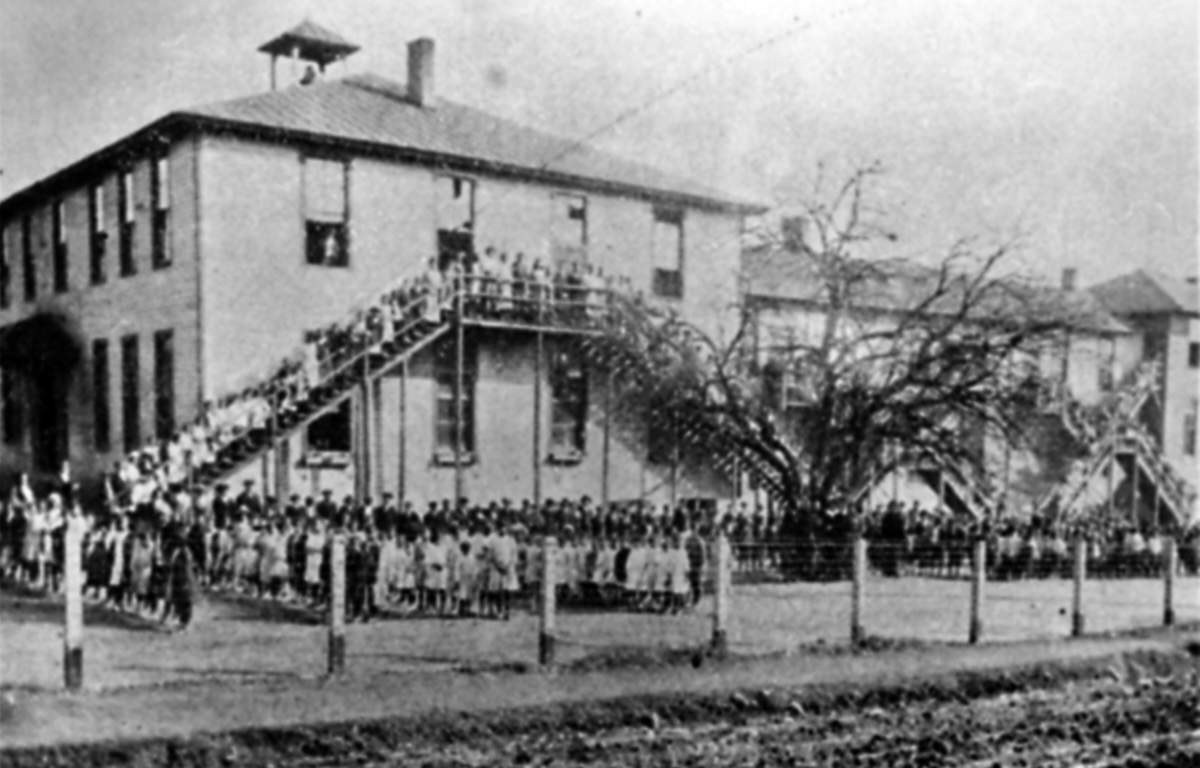
In 1886, W. R. Myers donated land at Myers and Stonewall streets in Logtown to establish the first graded school for Black students in Mecklenburg County. The school drove the neighborhood’s growth, as Black families left their rural homes to educate their children.
Myers Street Graded School in the late 1940s. Community members affectionately called it the Jacob’s Ladder School, a biblical reference to the building’s exterior staircase and to the opportunity for upward mobility. Courtesy of the Robinson-Spangler Carolina Room – Charlotte Mecklenburg Library.
The community continued to grow in popularity as prominent residents, such as Dr. J. T. Williams, architect W. W. Smith, and physician Dr. N. B. Houser, made the district their home.
By the early 1890s, Logtown had become Brooklyn – a fledgling city within a city, much like the town of Brooklyn on the verge of annexation by New York City.