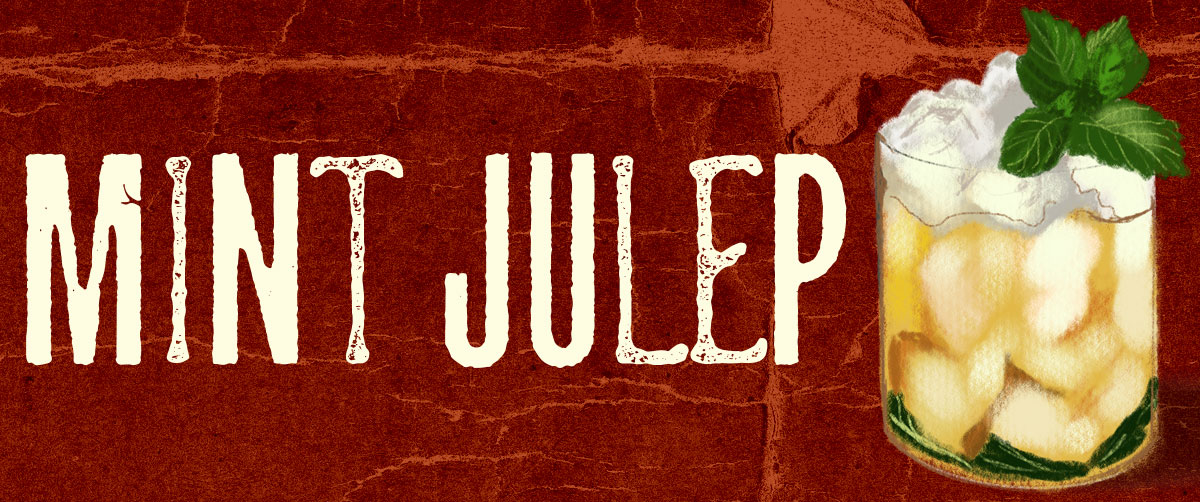
The mint julep is a famous southern cocktail. It is the official drink of the Kentucky Derby, one of the most and prestigious and well-known horse races in the United States. The Woodford Reserve Classic Mint Julep is made with 2 oz. ff Woodford Reserve, ½ oz of simple syrup, three fresh mint leaves, and crushed ice.
The mint julep dates to the ancient Persian word “gulab,” meaning rose water. By the 9th century, rose water had become a remedy for various respiratory and stomach illnesses. As gulab entered other cultures and regions, such as the Mediterranean, people began to substitute mint leaves for rose petals because of mint’s abundance in the area. The name gulab became “julab” and “jalupium” as the health elixir traveled with traders throughout the Roman, Egyptian, and Byzantium empires. In England, the drink took on the name “julep.”
The julep reached North America in the 1700s as a medicinal remedy. Virginia settlers began combing in strong rum or brandy with sweetened water and mint to make the beverage more palatable. This version of the julep quickly became the beverage of the elite, as they regularly had access to ice and sugar. They typically served the julep in silver stemware and enjoyed it at breakfast.
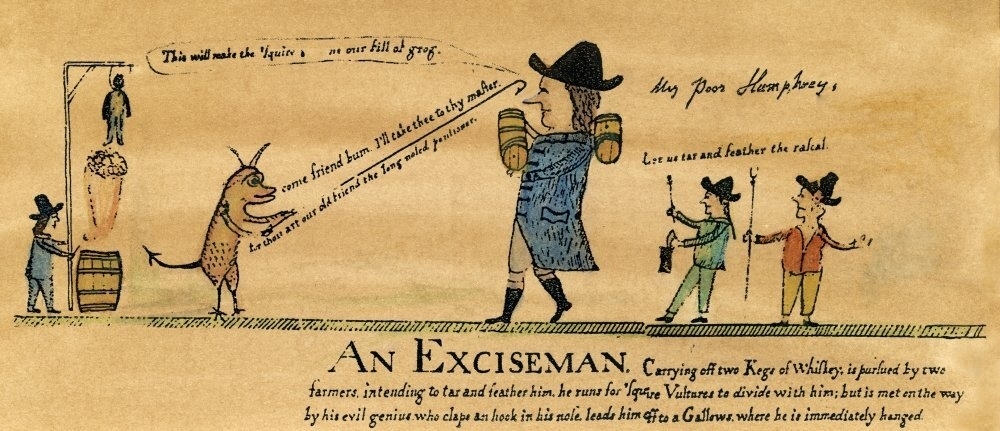
A political cartoon illustrating how farmers felt about a federal tax on whiskey made in the United States. This cartoon shows a tax collector or “exciseman” being chased by farmers only for him to be caught by “his evil genius” who then executes him. Farmers who engaged in the Whiskey Rebellion used many of the same tactics used by Americans to rebel against British taxes leading up to the American Revolution. They used political cartoons, attacked tax collectors, and destroyed their property. Courtesy of Atwater Kent Museum.
Bourbon, a corn whiskey created by American farmers, replaced the popularity of rum and brandy as these imported spirits became too expensive during the American Revolution. Bourbon increased in popularity after the Whiskey Rebellion of 1794–an uprising of farmers in western Pennsylvania against a new federal tax on distilled spirits. Farmers on this American frontier relied on whiskey as a form of currency, they did not have cash to pay federal taxes on whiskey, and many of them had not been paid for their military service in the Revolution. So, they resented this type of taxation from the federal government. When the farmers rebelled and refused to pay the tax, President George Washington personally led a militia of 12,000 troops to march to Pennsylvania to end the rebellion and to demonstrate the new national government’s power to enforce its own laws.
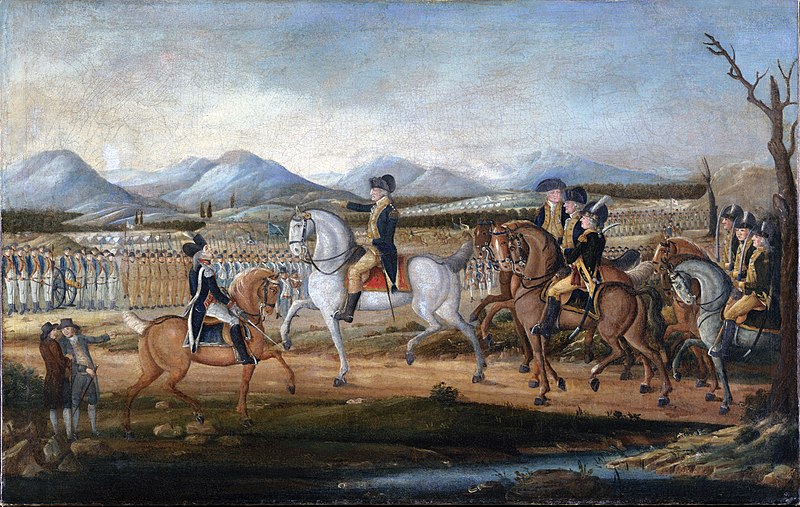
Painting depicting Washington Reviewing the Western Army at For Cumberland, Maryland, before marching to suppress the Whiskey Rebellion in Pennsylvania in 1794. Painting attributed to Frederick Kemmelmeyer. Courtesy of World History Encyclopedia and the Metropolitan Museum of Art.
After the Whiskey Rebellion, many of the rebellious farmers relocated to Kentucky when President Thomas Jefferson offered sixty acres to farmers for planting corn as their primary crop. Kentucky became the official home of bourbon after Jefferson named the region where the rebels settled Bourbon County after the French House of Bourbon.
It is challenging to attribute the “invention” of bourbon to a single individual, as the beverage has undergone significant evolution over time. In Pennsylvania, rye grew abundantly, but as new people entered Kentucky, corn became the latest star ingredient in American whiskey. At the same time, people like Elijah Craig made significant contributions to the evolution of the spirit. Craig was the first to age whiskey in charred oak barrels, a defining attribute for bourbon. Today, bourbon must be made in the United States, it must be at least 51 percent corn, and aged in new, charred oak barrels. It must be distilled at 160 proof and can have no added ingredients besides water.
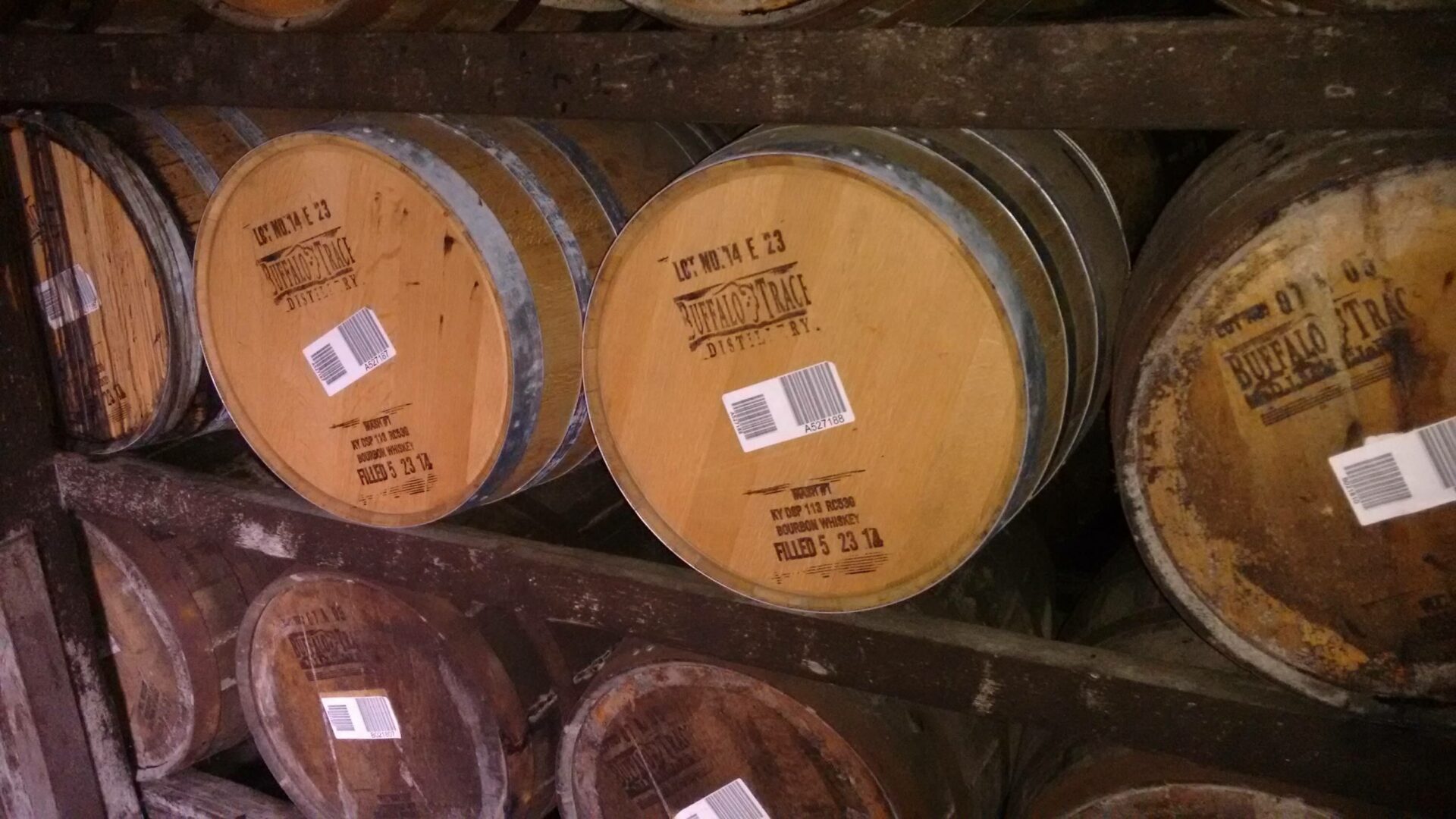
Barrels of bourbon from Buffalo Trace Distillery in Frankfort, Kentucky. Courtesy of Wikimedia Commons.
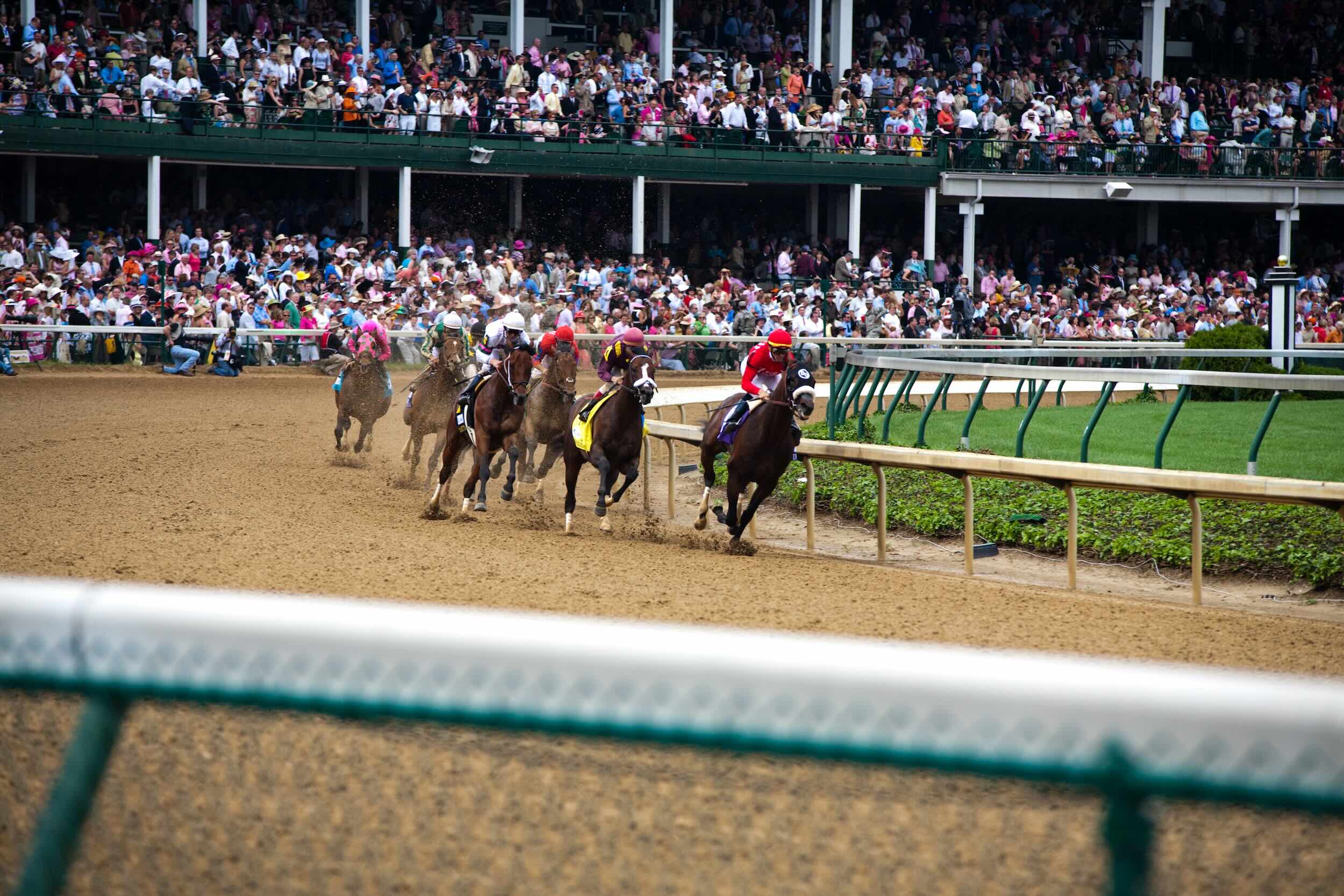
At the 2009 Kentucky Derby, horse racing shared the spotlight with the race’s signature sip: the mint julep. Courtesy of Wikimedia Commons. CC BY SA 2.0.
Today, the mint julep and the Kentucky Derby are inextricably linked. The mint julep has been associated with the Kentucky Derby since the 1820s, when references to winners receiving silver julep cups for first place wins first appeared. At the Derby’s Winner’s Party, the governor of Kentucky toasts the victor with a sterling silver julep cup. Each year, over 125,000 mint juleps are enjoyed over the two days of Kentucky Oaks and Kentucky Derby.
The mint julep is a popular drink that transcends regional boundaries beyond Kentucky and the rest of the South. While the mint julep is easy to make at home with any type of bourbon, mixologists of the artisan cocktail movement continue to build on its original recipe with experiments in preparation and presentation, spreading its popularity to new audiences.
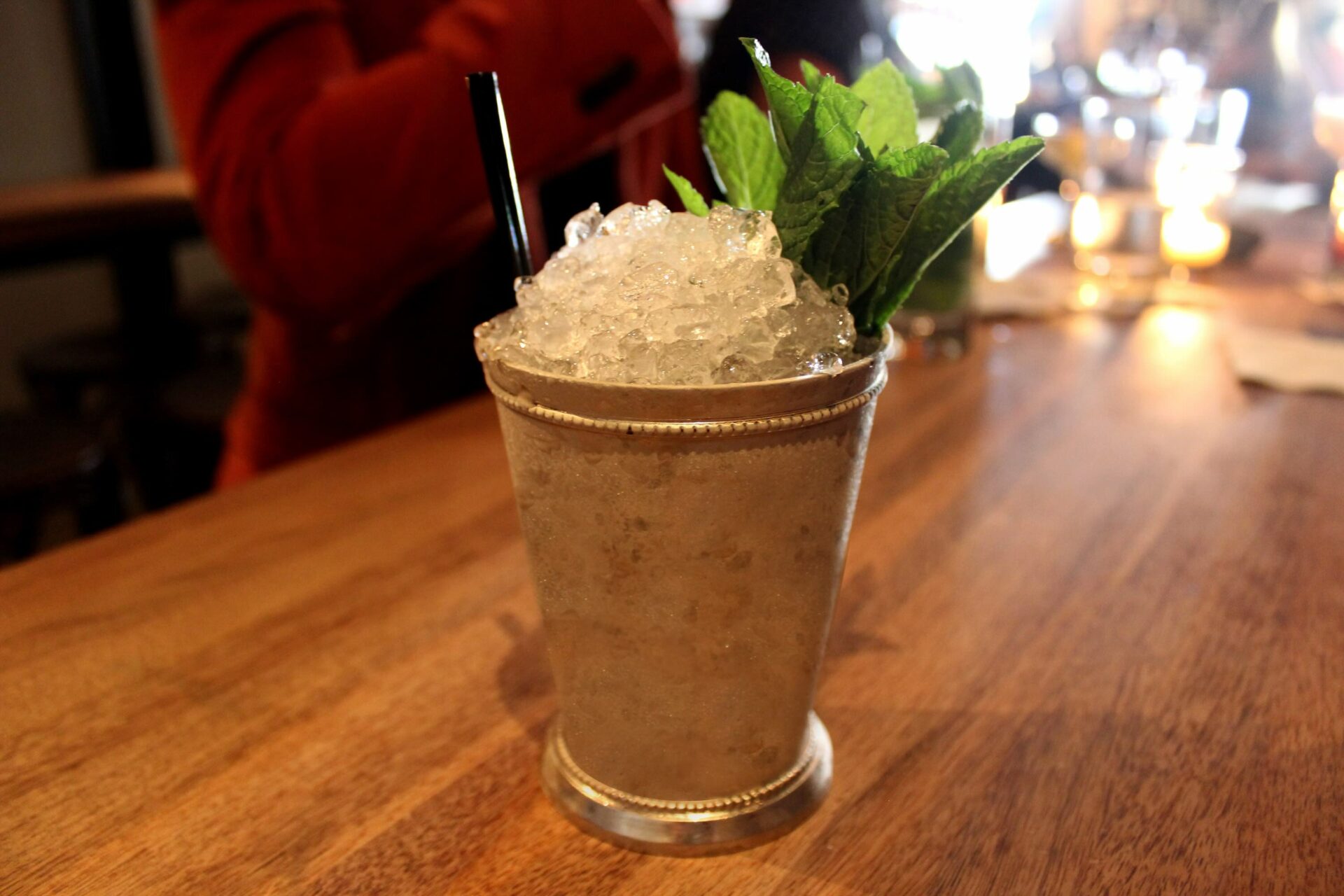
An ice-cold mint julep served in a silver cup. Courtesy of Will Shenton. CC BY-SA 3.0.